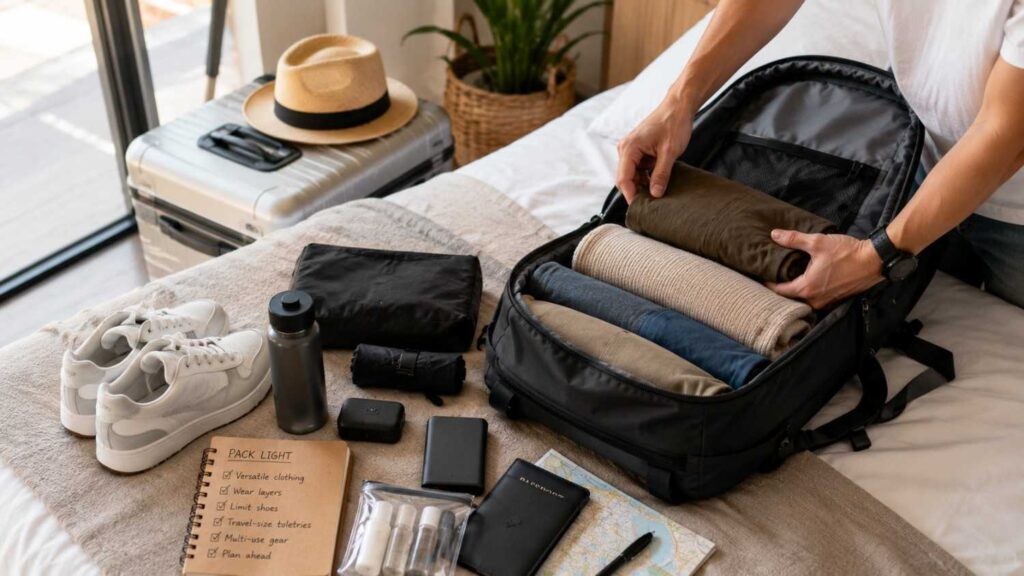
How to Pack Light for Long Trips Without Missing Essentials
Learning how to pack light for long trips becomes much easier when you stop preparing for every imaginable situation. Overpacking usually begins with uncertainty. Travelers add another jacket in case the weather changes, extra shoes in case a formal event appears, duplicate electronics in case one device fails, and large toiletries because they are unsure what will be available.
A better strategy is to pack for probable needs and create a reasonable backup plan for unusual circumstances. Most everyday products can be washed, repaired, borrowed, rented, or purchased during the trip. Important exceptions include medication, identification, visas, specialist accessibility equipment, prescription items, and professional tools that may be difficult to replace.
In my experience, successful minimalist travelers rarely depend on one perfect suitcase or packing accessory. They rely on a repeatable process. They check baggage rules, build a coordinated clothing system, plan laundry, limit duplicate functions, and test the finished bag before departure.
Light packing also improves the journey itself. A manageable bag is easier to lift, carry upstairs, place on public transport, store in a small room, and repack during a multi-city itinerary. It reduces the time spent waiting at baggage collection and lowers the risk of losing critical belongings in checked luggage.
The method in this guide works for international holidays, long business trips, extended visits, digital-nomad travel, and carry-on-only journeys. The quantities should always be adjusted for climate, planned activities, health needs, and local availability. The objective is not to follow a rigid universal checklist. It is to understand why each item deserves space and to build a compact travel system you can use confidently.
Related Articles
How to Pack Light for Long Trips by Planning First
Lightweight packing begins before any clothing enters the suitcase. Without a clear plan, travelers tend to collect individual items that seem useful but do not work together. The result may include several jackets, unrelated outfits, duplicate chargers, and footwear for activities that are not actually scheduled.
Start by dividing the itinerary into confirmed requirements and uncertain possibilities. Confirmed requirements may include business meetings, hiking days, religious sites, formal dinners, cold-weather travel, swimming, or remote work. Uncertain possibilities are events that might happen but have not been arranged. Pack fully for confirmed requirements and use adaptable clothing for the rest.
Next, identify how often you will change accommodation and how you will move between locations. A large wheeled suitcase may be manageable for a resort stay but inconvenient on trains, stairs, cobbled streets, or buses. Frequent movement makes bag weight and accessibility more important.
Create a written packing list before selecting individual products. Group it into clothing, footwear, toiletries, electronics, medication, documents, and destination-specific equipment. This makes duplication easier to identify.
The planning stage should also include a replacement strategy. Ask whether an item can be purchased, rented, borrowed, or washed if it becomes necessary. Basic toiletries, umbrellas, simple clothing, and inexpensive accessories are available in many destinations.
Planning first reduces emotional packing. It replaces vague anxiety with clear decisions based on the itinerary, available services, airline restrictions, and realistic risk. Once those decisions are made, the physical act of packing becomes faster and more controlled.
Pack for a Laundry Cycle, Not the Full Trip
A laundry cycle is the number of days you expect to travel before washing your clothing. For many long trips, a six- or seven-day cycle provides a practical starting point. You pack enough everyday clothing to reach the planned wash day, clean the garments, and repeat the same wardrobe system.
A general capsule may contain four or five tops, two or three bottoms, one warm mid-layer, one weather-resistant outer layer, sleepwear, and enough underwear and socks for the washing schedule. These numbers are not universal. Hot weather may require more lightweight tops, while cold destinations may require fewer base garments but better layers.
Plan where laundry will happen before departure. Your accommodation may provide a washing machine, paid laundry, or a nearby laundromat. Wash-and-fold services can be practical in some destinations. Sink washing works for lightweight items, but drying time, humidity, and available space should be considered.
Choose clothing that tolerates repeated wear and washing. Delicate pieces requiring special treatment are less suitable unless they are essential for work or an event.
Packing for a laundry cycle prevents the common mistake of bringing one complete outfit for every travel day. It also creates a repeatable method that can support a two-week journey, a month-long trip, or an even longer itinerary.
Many travelers also find that avoiding a few common packing mistakes makes it much easier to stick to a lightweight packing system throughout the journey.
| Trip Type | Recommended Bag | Clothing Strategy | Laundry Plan | Packing Priority |
|---|---|---|---|---|
| Weekend Getaway | Personal item or small carry-on | 2–3 outfits | Not required | Essentials only |
| One-Week Vacation | Carry-on suitcase | Capsule wardrobe | Optional | Versatile clothing |
| Two-Week International Trip | Carry-on + personal item | Mix-and-match outfits | Once during trip | Lightweight essentials |
| One-Month Travel | Carry-on backpack | Repeatable weekly wardrobe | Weekly laundry | Minimalist packing system |
| Multi-City Journey | Carry-on backpack | Layered clothing | Flexible | Easy organization and mobility |
Choose a Bag Before Finalizing the List
Selecting the bag early creates a useful physical boundary. When travelers choose all their belongings first and purchase luggage afterward, they often solve overpacking by choosing a larger suitcase. A fixed carry-on or compact checked bag forces more careful decisions.
A travel backpack can work well for stairs, uneven streets, public transport, and frequent accommodation changes. A wheeled case may be more comfortable in airports, hotels, and destinations with smooth surfaces. The better choice depends on the itinerary, your physical comfort, and how often the bag must be carried.
Review the bag’s external dimensions and empty weight. Wheels, handles, frames, pockets, and protective shells can reduce usable capacity or cause a bag to exceed airline limits. A heavy empty suitcase leaves less allowance for belongings.
The opening style also matters. A clamshell case provides easy access to the full contents, while a top-loading backpack may require more deliberate organization. Check the quality of zippers, handles, straps, and locking points.
Do not fill the bag completely during the first packing test. Leave enough space to repack without perfect folding and to accommodate food, laundry, or a small purchase. A bag that closes only when heavily compressed is difficult to manage throughout a long journey.
Build a Versatile Travel Capsule Wardrobe
A travel capsule wardrobe is a limited group of clothing designed to produce several practical outfit combinations. Instead of packing separate looks for each day, you select garments that coordinate in color, function, and level of formality. This reduces volume while still allowing variety.
Begin with the activities that appear most often in the itinerary. If most days involve walking, sightseeing, casual meals, and public transport, the majority of the wardrobe should support those activities. Do not allow one possible formal event to determine half the suitcase.
Layers are especially useful because they adapt to changing temperatures. A lightweight base layer, comfortable mid-layer, and weather-resistant outer layer can handle more situations than several bulky single-purpose garments. Each layer should fit comfortably over the previous one.
The wardrobe should also reflect local expectations. Some destinations or religious sites require covered shoulders, longer trousers or skirts, or less revealing clothing. Research these requirements before choosing the capsule.
Avoid building the system around items you rarely wear at home. Travel is not the ideal time to test an uncomfortable fabric, unfamiliar silhouette, or complicated care routine. Familiar clothing usually produces better decisions and fewer unused items.
Advanced travelers may create a simple outfit matrix before departure. List every top across one side and every bottom across the other, then confirm which combinations work. If a garment coordinates with only one other item, it may not deserve space unless it serves an essential specialist purpose.
Use a Coordinated Color and Fabric Strategy
Choose one or two neutral base colors and add a limited number of complementary shades. Neutral trousers, shorts, skirts, or outerwear can usually be combined with several tops. A smaller color range also reduces the need for separate shoes, belts, jackets, and accessories.
The strategy does not require wearing only black, grey, or beige. Color can still be included through tops, scarves, or smaller accessories. The important point is that the pieces work together rather than creating isolated outfits.
Fabric choice should reflect the destination. Lightweight synthetics often dry quickly, wool can manage temperature and repeated wear well, linen is useful in heat, and cotton may feel comfortable but dry more slowly. Each fabric has advantages and limitations. You do not need to purchase an expensive travel wardrobe if your existing clothing already performs adequately.
Test every garment before packing. Wear the proposed combinations, sit down, walk, and check whether the layers fit together. Confirm that the fabric is comfortable for long travel days and does not require difficult ironing or special cleaning.
Photograph successful combinations on your phone. This creates a simple visual reference during the trip and reduces daily decision-making. A coordinated color and fabric strategy makes a small wardrobe feel intentional rather than restrictive.
Limit Shoes and Wear the Bulkiest Pair
Footwear often occupies more space and adds more weight than travelers expect. Shoes are rigid, irregularly shaped, and difficult to compress. For many city, leisure, or mixed itineraries, one primary walking shoe and one lightweight alternative can cover most needs.
The primary pair should be comfortable for extended walking and suitable for the most common conditions. The secondary pair might be a lightweight sandal, casual shoe, or more presentable option for meals and evenings. Specialist hiking, formal, or sports footwear should be packed only when a confirmed activity requires it.
Wear the heaviest and bulkiest pair during transit. Pack the lighter shoes heel-to-toe inside a separate bag or cover to protect clean clothing. Small items such as socks can be placed inside the shoes, provided everything remains clean and easy to inspect.
Do not rely on completely new footwear. Test shoes before departure and confirm that they remain comfortable during a long day. Blisters or poor support can disrupt an itinerary more seriously than repeating the same style.
Consider climate and maintenance as well. Waterproof shoes may help in wet destinations, while highly insulated footwear can become uncomfortable in warm conditions. The best travel shoe is not the most fashionable or technically advanced option. It is the pair that safely supports the activities you will actually perform.
Reduce Toiletries Without Sacrificing Your Routine
Toiletries can add significant weight because travelers often pack full-size bottles, duplicate products, and quantities far beyond what the trip requires. A more efficient system begins by measuring actual use rather than guessing.
Observe your routine for one week before departure. Note how much shampoo, cleanser, moisturizer, toothpaste, and other products you genuinely use. This gives you a more accurate estimate than automatically filling every travel container.
Divide toiletries into essential, optional, and destination-available categories. Essential items include prescription treatments, products required for allergies or medical conditions, and anything difficult to replace. Optional items may include additional styling products or several products with similar functions. Destination-available items include basic soap, shampoo, and toothpaste that can usually be purchased locally.
Check what your accommodation provides. Hotels may supply soap, shampoo, towels, and hair dryers. Apartments may include laundry detergent or cleaning products. Confirming these details can remove several items from the bag.
Use containers appropriate to the actual trip length. A smaller bottle that lasts ten days can be refilled or replaced during a month-long journey. Carrying a full month of every product is not always necessary.
Keep leak-prone liquids in a separate sealed pouch and avoid overfilling reusable containers. Pressure changes and loose lids can cause spills.
The objective is not to abandon a routine that supports your health or comfort. It is to remove unnecessary quantity, duplicate functions, and packaging while keeping the products that genuinely matter.
Understand Carry-On Liquids Rules
For flights screened by the Transportation Security Administration, standard liquids, aerosols, gels, creams, and pastes in carry-on baggage are generally restricted to containers holding no more than 3.4 ounces or 100 milliliters. These containers must fit inside one quart-sized, transparent, resealable bag.
European aviation-security guidance also commonly applies a 100-milliliter container limit within one transparent, resealable one-liter bag. Exemptions may apply to essential medicines, baby products, and certain duty-free purchases, but the requirements and screening procedures should be checked through the relevant official authority.
The container’s maximum capacity matters, not the amount remaining inside it. A 200-milliliter bottle containing only a small amount may still be rejected under standard rules.
Security technology and local procedures can vary between airports. Do not assume that a modern scanner automatically removes the need to follow published restrictions. Rules may also differ on the return journey.
Label reusable bottles clearly and use containers designed for travel. Avoid carrying unidentified liquids, particularly medication or specialist products.
Place the liquids bag where it can be removed quickly if requested during screening. Efficient organization reduces stress for both the traveler and security staff. Checking official guidance shortly before departure is essential because procedures can change.
Replace Duplicates With Multipurpose Options
Multipurpose products can reduce the number of containers in your bag, but they should be selected carefully. The goal is to remove genuine duplication, not to force one product into several roles it cannot perform effectively.
A daytime moisturizer containing suitable sun protection may reduce the need for a separate facial product. One gentle cleanser may replace several specialized cleansers. A simple soap may be suitable for both hands and body. These choices depend on personal needs, allergies, skin conditions, and destination climate.
Solid toiletries may reduce liquid volume and leakage risk. Shampoo bars, solid soap, deodorant sticks, and toothpaste tablets can be useful, but they are not automatically lighter once containers and storage are included. Test them before the trip rather than changing your entire routine during travel.
Avoid carrying large backup quantities of products that are widely available at the destination. Replacing toothpaste or shampoo locally is usually easier than carrying unnecessary weight for several weeks.
Medication should remain separate from general toiletries. Keep prescription products in their original labeled packaging when required, and carry enough for the journey plus a reasonable delay allowance.
A good toiletry kit supports hygiene, comfort, and medical needs without becoming a miniature bathroom cabinet. Every product should have a clear function and an appropriate quantity.
Simplify Electronics and Organize Your Carry-On
Electronics frequently become the heaviest part of a minimalist packing list. A phone, laptop, tablet, camera, headphones, power bank, adapters, chargers, and several cables can add substantial weight before clothing is considered.
Begin by listing every device and its purpose. If two devices perform nearly the same role, decide whether both are necessary. A smartphone may replace a camera, guidebook, scanner, notebook, alarm clock, navigation device, and entertainment system for many travelers.
Work requirements may justify a laptop, external drive, or specialist equipment. Leisure travelers may be able to leave these items behind. Remote workers should distinguish between essential professional tools and optional accessories that provide only minor convenience.
Check electrical standards and plug types for the destination. A compact, suitable adapter may replace several individual plugs, although voltage compatibility must also be confirmed for appliances.
Organize electronics so they are easy to remove during security checks and difficult to forget in an accommodation. One dedicated pouch can hold cables, adapters, memory cards, and small accessories.
Back up important files before departure. Store essential travel documents securely in more than one location, but do not rely entirely on internet access.
The goal is not to remove technology that supports the trip. It is to avoid carrying devices that duplicate functions, require several accessories, or remain unused. A smaller electronics kit reduces weight, charging time, cable clutter, and the number of valuable items that must be protected.
Build One Compact Charging Kit
A compact charging kit should support every essential device without containing unnecessary duplicates. Start by checking which products can share cables, plugs, or charging standards. Where practical, a suitable multiport charger can replace several individual adapters.
Carry only the cable lengths you need. Extremely long cables add bulk, while very short cables may be inconvenient in hotel rooms with poorly placed sockets. Label similar cables if confusion is likely.
Include a destination-appropriate plug adapter and confirm whether your devices support the local voltage. Many modern phone and laptop chargers accept a broad voltage range, but this should be verified on the charger label or official documentation.
Power banks and spare lithium batteries require particular attention. FAA guidance states that spare lithium batteries and power banks must remain in cabin baggage rather than checked luggage. Their terminals should be protected from short circuits, and damaged or recalled batteries should not be carried.
If your carry-on is taken at the gate and placed in the aircraft hold, remove power banks and spare batteries first. Larger-capacity batteries may require airline approval or may be prohibited.
Store the complete charging kit in one pouch and return each item after use. This simple habit reduces the risk of leaving a cable or adapter behind when changing accommodation.
Use Packing Cubes as Organizers, Not Extra Storage
Packing cubes are most useful as an organizational system. They divide a bag into clear categories, make repeated packing faster, and help travelers find clothing without emptying the entire suitcase.
A simple arrangement may include one medium cube for main clothing, one smaller cube for underwear and sleepwear, and one separate pouch for laundry or accessories. More compartments are not always better. Too many cubes can add weight and create rigid spaces that are difficult to arrange.
Compression cubes can reduce the volume of soft clothing, but they do not reduce its weight. Compression may encourage travelers to add more items until the bag exceeds an airline’s weight limit. Use the extra space for easier packing, not as permission to carry unnecessary belongings.
Rolling works well for many T-shirts, soft trousers, leggings, and casual garments. Folding may protect structured shirts, jackets, or fabrics that crease easily. Combining both methods usually produces the best result.
Do not compress damp or dirty clothing for long periods. Use a breathable laundry bag where possible.
The right packing system should remain easy to maintain during the trip. If organizing the bag requires a complicated process every morning, simplify it. Packing cubes should reduce friction, not create another task.
Protect Documents, Medication, and Critical Essentials
Packing lightly should never involve removing items that protect your health, identity, finances, or ability to complete the journey. A compact suitcase is not useful if essential medication is inaccessible, a passport is lost, or important travel records are stored only on a device without power.
Critical belongings should remain in a personal item that stays with you. Carry-on bags can sometimes be checked at the gate when overhead space is limited, so medication, documents, batteries, valuables, and immediate necessities should not depend on remaining in the larger cabin bag.
Organize documents according to the itinerary. Depending on the journey, this may include a passport, visas, residence permits, insurance information, vaccination records, accommodation details, transport bookings, driver documentation, and emergency contacts.
Use secure digital copies, but maintain an appropriate physical backup. Online storage may be unavailable during a network outage or account problem. Sensitive information should be protected rather than stored openly in an unlocked phone gallery.
Medication requires destination-specific research. A product that is available without restriction at home may be controlled or prohibited elsewhere. Check official embassy, customs, or health information before departure.
Financial preparation also supports light travel. Carry more than one payment method and keep them in separate locations. Do not place every card, all cash, and identification in a single wallet.
The principle is simple: reduce replaceable belongings aggressively, but protect irreplaceable essentials carefully. Light packing should improve mobility without creating unnecessary exposure to health, legal, or financial problems.
| Item Category | Priority Level | Reason for Inclusion |
|---|---|---|
| Passport & Travel Documents | Essential | Required for travel and identification |
| Prescription Medication | Essential | Important for health and emergencies |
| Clothing Basics | Essential | Daily comfort and weather protection |
| Electronics | Important | Communication, navigation, and work |
| Toiletries | Important | Personal hygiene during the trip |
| Extra Shoes | Optional | Only if needed for planned activities |
| Travel Accessories | Optional | Added convenience without being necessary |
| “Just in Case” Items | Low Priority | Often increase luggage weight unnecessarily |
Create a Small Essential-Items Kit
An essential-items kit should contain the belongings you would need if your main suitcase were delayed, checked unexpectedly, or temporarily inaccessible. Keep it compact enough to remain in your personal item throughout the journey.
Typical contents include your passport, wallet, phone, prescription medicine, necessary over-the-counter medication, charging cable, power bank, travel documents, glasses or contact-lens supplies, and essential medical equipment. A clean top and basic hygiene items may also be useful on a long journey.
The CDC advises travelers to carry enough medication for the trip plus additional supplies for possible delays. The U.S. Department of State also recommends checking whether medicines are legal at the destination and carrying copies of prescriptions or supporting medical documentation when appropriate.
Keep prescription medicine in labeled packaging when required. Avoid transferring tablets into unidentified containers merely to save a small amount of space.
Store emergency contact information in both digital and physical form. Include travel-insurance details and any relevant medical information that would help another person assist you.
The kit should remain organized and easy to inspect. Use a small pouch or dedicated section rather than allowing important items to disappear among snacks, cables, and clothing. Accessibility is more important than extreme compression.
Perform a Final Weight-and-Use Test
Pack the complete bag several days before departure rather than waiting until the final evening. Weigh it with a luggage scale and compare the result with the strictest allowance across the itinerary.
Dimensions matter as much as weight. Confirm that external pockets, wheels, handles, and straps remain within the airline’s measurement limits. A soft bag can become oversized when every compartment is filled.
Carry or roll the packed bag for at least 15 minutes. Use stairs, walk around the building, and lift it carefully to a height similar to an overhead compartment. This test can reveal uncomfortable straps, poor balance, excessive weight, or difficult handles.
Open the bag and retrieve common items such as a jacket, liquids pouch, document folder, and charging cable. Frequently used belongings should be accessible without unpacking everything.
If reduction is necessary, remove items in a logical order. Start with duplicate clothing, speculative outfits, extra shoes, full-size toiletries, books, and electronics without a confirmed purpose.
Ask one final question about every uncertain object: “What realistic problem does this solve?” If the answer remains vague and the item is easy to replace, remove it. A final test turns the packing plan into a practical system rather than a theoretical checklist.
Reviewing a few practical packing strategies before your trip can also help identify unnecessary items and keep your luggage manageable.
Quick Answer About How to Pack Light for Long Trips
To understand how to pack light for long trips, begin by packing for one repeatable laundry cycle instead of every day on the calendar. Choose a carry-on or compact suitcase that meets the strictest airline limit on your itinerary, then build a coordinated wardrobe in which most tops, bottoms, layers, and shoes work together. Keep toiletries small, reduce duplicate electronics, and carry medication, travel documents, spare batteries, and other critical items in your personal item.
The process becomes easier when every item must justify its space. Pack objects you expect to use regularly, items that would be difficult to replace, and essentials connected to health, safety, identity, or work. Remove speculative outfits and products included only for vague “just in case” situations.
Long-term travel does not always require more clothing than a short holiday. Access to laundry, the destination climate, and the variety of planned activities matter more than the total number of travel days. A traveler spending a month in cities with weekly laundry may need almost the same wardrobe as someone taking a ten-day trip.
Before departure, confirm the operating airline’s current cabin-baggage dimensions and weight allowance. IATA explains that carry-on rules vary by airline, aircraft, route, and travel class, so a bag accepted on one flight may not meet another carrier’s requirements.
The Core Principle of Light Packing
Packing light is not a competition to carry the fewest possible belongings. It is a practical method of selecting the smallest collection of items that can support your itinerary comfortably, safely, and efficiently. The goal is to reduce unnecessary weight without creating avoidable problems during the journey.
A useful item should normally meet at least one clear condition. You expect to use it repeatedly, it serves an important health or safety function, or it would be difficult or expensive to replace at the destination. Items that do not meet any of these conditions should be questioned before they enter the bag.
For long trips, the time between laundry opportunities is usually more important than the total trip length. A traveler with access to laundry every six or seven days does not need a fresh outfit for every day of a month-long journey. The same clothing can be washed, recombined, and layered.
This principle changes packing from a calendar-based activity into a reusable system. Instead of preparing for every possible situation, you prepare for the most likely conditions and create a realistic plan for washing, replacing, renting, or buying anything unusual that becomes necessary.
What You Should Check Before Packing
Begin with the itinerary rather than opening the suitcase. Review the expected weather, cultural expectations, accommodation types, transportation methods, planned activities, work requirements, and access to laundry. A hotel-based city trip needs a different packing system from trekking, camping, cruising, or moving frequently between rural areas.
Check the official baggage page of every operating airline on your route. Pay attention to external dimensions, weight restrictions, personal-item allowances, and whether wheels and handles are included in the measurement. When several airlines are involved, use the strictest allowance as your working limit.
Review official security guidance for liquids, batteries, medication, and restricted items. Rules can vary by country, airport, destination, and product type. Do not rely entirely on advice from an old blog post or a previous trip.
You should also confirm what your accommodation provides. Towels, toiletries, hair dryers, laundry facilities, irons, and kitchen supplies may already be available. Carrying duplicates wastes space.
Finally, identify anything that cannot be replaced easily, including prescription medicine, accessibility equipment, official documents, specialist work tools, and custom-made items. These essentials deserve priority before optional clothing, entertainment, or backup products are considered.
Frequently Asked Questions About How to Pack Light for Long Trips
Questions about long-trip packing usually focus on quantities, airline restrictions, clothing organization, and the fear of leaving behind something important. The best answers depend on the itinerary rather than the number of travel days alone.
Climate, cultural expectations, medical needs, work responsibilities, accommodation type, and laundry access all affect what belongs in the bag. A traveler visiting several European cities in mild weather has different requirements from someone combining mountain trekking, formal events, and remote work.
The purpose of minimalist travel packing is not to impose the same list on everyone. It is to create a system that helps each traveler distinguish between essential, useful, replaceable, and unnecessary items.
Beginners often focus on fitting everything into the suitcase. More experienced travelers also consider weight distribution, accessibility, repacking speed, security, and the effect of carrying the bag through stations, stairs, and crowded streets.
Official rules should always take priority over general advice. Airline baggage limits, liquids policies, medication restrictions, and battery requirements can change. Check the operating airline, airport-security authority, and destination government before departure.
The following answers provide a practical foundation for common situations. They should be adapted rather than followed mechanically. The right packing list is the lightest one that supports the confirmed itinerary safely and comfortably.
Can You Travel for a Month With Only a Carry-On?
Many travelers can complete a month-long journey with one carry-on, provided they have regular access to laundry and do not need bulky specialist equipment. The total duration matters less than the number of days between washing clothes.
A repeatable wardrobe of coordinated tops, bottoms, layers, underwear, and two practical pairs of shoes can support several weeks of travel. Toiletries can be refilled or replaced, while digital documents and entertainment reduce the need for paper items.
However, carry-on-only travel may not suit every itinerary. Cold-weather equipment, camping gear, professional tools, accessibility devices, formal clothing, or specialist sports equipment can require additional space. Airline weight limits may also be restrictive even when the bag meets the required dimensions.
The goal should not be to force every trip into one bag. It should be to avoid carrying belongings without a clear purpose.
Before committing to carry-on-only travel, pack the full bag, weigh it, and test whether you can carry it comfortably. Confirm laundry access and identify which basic supplies can be purchased locally. A carefully planned carry-on can support a month, but the decision should remain practical rather than ideological.
How Many Clothes Should I Pack for Two Weeks?
For a typical two-week trip with access to laundry, begin with four or five tops, two or three bottoms, one warm layer, one outer layer, sleepwear, and enough underwear and socks to reach the planned wash day.
These quantities should be adjusted for the destination. Hot and humid conditions may require more lightweight tops because clothing needs frequent washing. Cold weather may require fewer visible outfits but more effective thermal layers. Business travel may involve additional shirts or formal pieces.
The most efficient wardrobe is one in which nearly every top works with every bottom. A garment that creates only one outfit takes up more space than a versatile piece that produces several combinations.
Plan laundry before departure. If you know where and when you will wash clothing, you can pack with greater confidence. Include a small laundry bag and any specialist detergent required for sensitive fabrics.
Do not count clothing only by category. Consider actual activities. Two weeks containing hiking, swimming, formal meetings, and casual sightseeing may require a broader wardrobe than two weeks of city travel.
The numbers are a starting framework, not a strict rule. Comfort, hygiene, climate, and confirmed activities should guide the final list.
Do Packing Cubes Actually Save Space?
Packing cubes can reduce wasted gaps and compress some soft clothing, but their main value is organization rather than weight reduction. They help separate clothing categories, protect clean garments from laundry, and make repeated packing faster during a multi-stop trip.
Compression cubes may reduce volume by removing air from soft items. This can be useful in a small bag, but it may also encourage overpacking. A compressed suitcase can still exceed the airline’s weight limit.
Cubes work best when each has a clear role. One may hold main clothing, another may contain underwear and sleepwear, and a separate pouch can manage laundry. Using too many small organizers can add weight and make the bag less flexible.
The shape of the luggage also matters. Rectangular cubes often fit structured suitcases well, while a soft backpack may benefit from fewer or more flexible organizers.
Travelers do not need premium packing cubes to pack effectively. Lightweight pouches or existing organizers may perform the same function.
Use cubes if they reduce search time and make repacking easier. Avoid them if they create unnecessary structure or encourage you to carry more than you need. Their success should be measured by convenience, not simply by how tightly clothing can be compressed.
Is Rolling Better Than Folding Clothes?
Rolling and folding are both useful, and the best choice depends on the garment, fabric, and shape of the bag. Rolling works well for many T-shirts, soft trousers, leggings, underwear, and casual clothing because it creates compact shapes that fit into small gaps.
Folding is often better for structured shirts, blazers, dresses, and fabrics that crease easily. These garments may remain neater when folded along their natural seams and placed near the top of the bag.
A combination usually produces the most efficient result. Fold structured items, roll flexible garments, and use socks or underwear to fill irregular spaces. Packing cubes can hold either method.
Rolling does not reduce the weight of clothing. It may reduce volume, but tighter packing can make the bag heavier if the extra space encourages additional items.
Test the method with your actual wardrobe before departure. Pack the bag, leave it closed for several hours, then inspect the clothing. This reveals which fabrics wrinkle or compress poorly.
The most practical method is the one that keeps garments organized, accessible, and wearable without requiring extensive ironing. There is no universal rule that rolling is always superior.
How Many Pairs of Shoes Should I Take?
For many urban, leisure, or mixed-purpose trips, two pairs of shoes are sufficient. One should be a reliable primary walking shoe suitable for long days. The second can be a lighter sandal, casual shoe, or more presentable option for evenings.
Additional footwear should be connected to a confirmed requirement. Technical hiking, formal business events, specialist sports, snow, or water activities may justify another pair. Avoid packing shoes for activities that are merely possible.
Wear the bulkiest and heaviest pair during travel. Pack the lighter pair in a separate shoe bag and use the interior for clean socks or small accessories.
Comfort matters more than variety. A versatile shoe worn repeatedly is more valuable than several fashionable pairs that cause pain or remain unused. Break in footwear before departure and test it during a full day of walking.
Consider weather resistance, grip, breathability, and cultural expectations. One pair may not perform well in both heavy rain and extreme heat.
Shoes consume valuable space, so each pair should support several outfits or a necessary activity. If a shoe serves only one uncertain occasion, it is usually a strong candidate for removal.
Can a Power Bank Go in Checked Luggage?
Power banks and spare lithium batteries should not be placed in checked luggage. FAA and IATA guidance requires them to remain in cabin baggage because a battery incident can be identified and managed more effectively inside the aircraft cabin.
Protect the terminals against short circuits. Keep the power bank in its original case, a protective pouch, or another arrangement that prevents contact with metal objects. Do not carry damaged, swollen, leaking, or recalled batteries.
Check the battery’s watt-hour rating before travel. Larger-capacity batteries may require airline approval or may not be permitted. The rating is usually printed on the device or its technical label.
If airline staff require your carry-on bag to be checked at the gate, remove power banks, spare batteries, electronic cigarettes, and other cabin-only items first. Keep them in your personal item.
Do not rely solely on general guidance. Review the current policy of the operating airline, especially when carrying specialist batteries, camera equipment, mobility devices, or large charging systems.
A compact power bank can be useful during long travel days, but it should be carried responsibly. Safe storage and compliance are more important than maximizing capacity.
Conclusion
Packing light is a structured decision-making process rather than a last-minute attempt to force everything into a smaller suitcase. The most reliable system begins with itinerary research, airline rules, laundry access, and a clear understanding of the activities you will actually perform.
Choose the bag before finalizing the list so it creates a physical limit. Build a coordinated capsule wardrobe, use layers, restrict footwear, and carry enough clothing to reach the next planned laundry day. Reduce toiletries by measuring actual use and removing duplicate functions.
Electronics should be selected according to confirmed needs. A smartphone may replace several devices, while a compact charging kit can reduce cable clutter. Keep power banks and spare lithium batteries in cabin baggage according to current safety requirements.
Critical items deserve a different standard. Medication, identification, travel documents, accessibility equipment, and essential professional tools should not be removed merely to achieve a lighter bag. Store them where they remain accessible even if the main carry-on is checked unexpectedly.
The final packing test is essential. Weigh the bag, carry it, lift it, and retrieve frequently used items. This reveals practical problems that a written checklist cannot show.
Ultimately, the best packing system is the one you can maintain throughout the trip. A bag that is easy to organize, comfortable to move, and flexible enough for changing circumstances provides more value than a perfectly compressed suitcase that is difficult to use.
The Main Lesson
The central lesson in how to pack light for long trips is to separate genuine requirements from imagined possibilities. Pack for the confirmed itinerary, likely weather, cultural expectations, health needs, and essential work responsibilities.
Replace vague “just in case” items with realistic alternatives. Clothing can often be washed, simple products can be purchased, equipment can sometimes be rented, and minor problems can be solved locally. You do not need to carry a physical solution for every unlikely situation.
This approach does not mean ignoring risk. Medication, official documents, accessibility devices, and difficult-to-replace specialist items deserve priority. The goal is to reduce replaceable belongings while protecting essentials.
A light bag also requires current information. Verify airline dimensions and weight limits, airport-security rules, destination medication restrictions, and battery policies before departure. Requirements can vary and may change.
Minimalist packing becomes easier with experience. After each journey, note what you used repeatedly, what remained untouched, and what you wished you had packed. These observations improve the next list.
The best result is not the smallest possible suitcase. It is a practical bag that supports the journey without controlling it.
Your Next Step
Create a draft packing list at least one week before departure. Organize it by category and mark every item as essential, useful, replaceable, or optional. Remove optional items first and review replaceable items carefully.
Pack the full bag several days early. Weigh it and compare the result with the strictest airline allowance. Carry it around, use stairs, and test whether you can lift it safely. Confirm that documents, liquids, medication, and electronics are easy to access.
Review the itinerary one final time. Make sure confirmed activities are covered and remove clothing or equipment linked only to uncertain possibilities. Check accommodation amenities and laundry access.
Take a photo of the final contents or save the list. During the trip, note which items you actually use. This creates reliable information for future journeys.
If the bag still feels heavy, remove one duplicate garment, one unnecessary shoe, one full-size toiletry, or one electronic accessory at a time. Small reductions can make a noticeable difference.
The process should produce confidence rather than anxiety. Once every item has a clear purpose, close the bag and stop adding last-minute extras.